

Features of New Zealand Fur Seals
New Zealand fur seals are distinguished by visible external ear flaps and hind flippers which rotate forward, allowing them to move quickly on land.
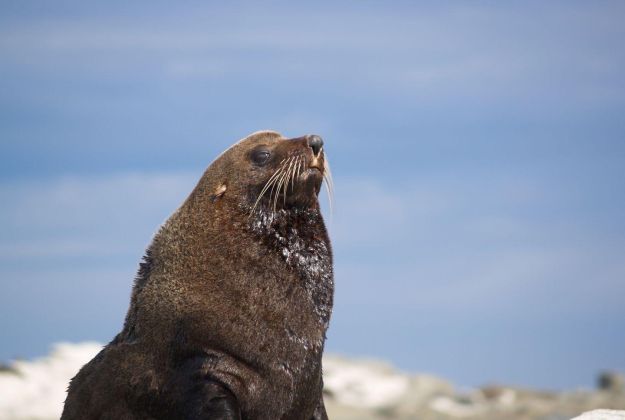
This pointy-nosed fur seal has long pale whiskers and a body covered with two layers of fur. Their coat is dark grey-brown on the back, and lighter below; when wet kekeno look almost black.
Kaikōura Kekeno seals are very good swimmers and weaned pups can turn up almost anywhere around New Zealand. On land they sometimes become disoriented and have been found in unusual places such as backyards, drains and streets.
How Big can Kaikōura Fur Seals Get?
- Adult females can reach a maximum length of 1.5 m, weighing up to 30-50 kg.
- Adult males can grow up to a maximum length 2.5 m, weighing up to 90-150 kg.
New Zealand Fur Seal Population
In New Zealand, minimum estimates of the fur seal population are 50 - 60,000, but this is almost certainly an underestimate. Recent work in Otago has shown there was a population increase of 25% per year between 1982 and 1994, with surveys in 1995 indicating this growth was continuing.
A similar rate of increase has been noted in the Nelson / Marlborough region and also in the Sub-Antarctic Bounty Islands. Since 1991, the fur seal population has recommenced breeding on the North Island.
Fur Seal Diet and Foraging
Kekeno seals feed mainly on squid and small mid-water fish but also take larger species such as conger eels, barracuda, jack mackerel and hoki mostly off the continental shelf in depths greater than 22 metres.
The New Zealand fur seal dives deeper and longer than any other fur seal. Female fur seals on the West Coast are known to occasionally dive deeper than 238 metres, spending as long as 11 minutes underwater!
Most dives are only 1-2 minutes long. Most of their prey species follow a vertical migration, meaning they come nearer the ocean's surface in the middle of the night, and sink back to deeper depths during the day.
In autumn and winter, fur seals dive much deeper, with many dives reaching than 100m under the surface. At least some female seals dive deeper than 240m, and satellite tracking shows they may forage up to 200km beyond the continental slope in water deeper than 1000m.
The Life Cycle of Fur Seals
The average life span of New Zealand fur seals is 14-17 years.
The Kekeno fur seal spends a lot of their time on rocky shores, at sites called haul-outs. Every year, these sociable animals return to the same area for the breeding season - from mid-November to mid-January.
Females reach sexual maturity between 4 and 6 years and will give birth to a single pup almost every year. Females mate 6-8 days after the birth of their pup, even before their first foraging trip. Delayed implantation means the egg is fertilised, but doesn't implant in the uterine wall to begin development for another 3 months.This means the gestation period is about 9 months, even though the female is mated 360 days before she gives birth.
Females alternate foraging trips (periods of 1-20 days at sea) to feed, with attendance periods (1-2 days), where they are at the rookery to suckle the pup. Seal pups are suckled for about 300 days, although some will continue to suckle into their second year. Pups start to feed on solid food before weaning, and spend a large proportion of time playing with other pups and objects such as seaweed and reef fish. We love spotting them playing on the Kaikōura coastline during our kayak tours!
Juvenile fur seals have been found over 1000 km from their place of birth.
Male fur seals are sexually mature at 5 - 6 years old, but are unlikely to be socially mature (able to hold a territory) for at least another 3 years. Dominant bulls put on displays of glaring and posturing and fighting with other males just prior to the breeding season to gain territories.
Fur seals are polygamous breeders, and a male may mate with many females in a single breeding season.
Fur Seal Yearly Cycle
Aug-Nov:Weaning and dispersal in the Spring
Dec-Jan: Pup birth and mating in Summer
Feb-July:Pup nursing and winter haul-out
The Predators of Fur Seals
Great white sharks and sevengill sharks are the main predators of Kaikōura seals. New Zealand sea lions may occasionally hunt juvenile fur seals in the sub-Antarctic islands but this has not been reported on the mainland.
How Humans Impact Fur Seals
New Zealand fur seals ranged around New Zealand before the arrival of humans, with a population of about 2 million seals.
They were used as a food source by Maori. The onset of European sealing for meat and pelts in the 1700s and 1800s then pushed them to the brink of extinction.
In 1894 Kekeno Kaikōura seals became fully protected, and at 15% of their former population are now becoming increasingly common.
Human disturbance and activity are the causes of most threats to the Kekeno fur seal population today. This includes entanglement in fishing gear and marine debris, and harassment by the public.
Rules for Observing Kaikōura Seals
Respecting the seals creates a safer, healthier viewing experience for both you and the seals!
- Observe the seal quietly
- Always keep dogs and small children well away from seals
- Avoid getting nearer than 20 metres to the seal
- Do not touch the seal under any circumstances
- Do not get between the seal and its access to water
- Do not feed the seals
All Kaikōura seals should be treated with caution. They have large teeth, and can easily become aggressive. They also move surprisingly fast on land! A fur seal can bite with up to 2 tonnes per cm pressure, causing serious damage.
Do not feed the seals. Feeding them dead fish and human food isn't a treat, it disrupts their natural diet and bacteria that naturally occurs on our skin is harmful to their digestive system.
Do not attempt to move or assist adults or pups. Even if it is sick or injured it may be capable of inflicting serious injury. Seals also harbour infectious diseases that can be transmitted to humans, and are difficult to treat.
You cannot keep a kekeno seal as pet. Possessing a fur seal, or any other species of seal, without a permit is illegal.
When to Contact Department of Conservation
If you find a fur seal that is:
- Severely injured
- Entangled in marine debris
- Being harassed by people or dogs
- Kaikōura seals sometimes turn up in unexpected places. They usually move on but in some cases they may need help.
Call the DOC Hotline on Freephone 0800 362 468.
When Not to Contact DOC
The following is normal behaviour for kekeno fur seals:
- Regurgitating, sneezing or coughing
- Crying, these are natural moisture secretions
- A young seal drifting away from its mother flapping its flippers in the air as if stranded
- Immobile seals
- Fighting seals